Class 1, Class 2, vs. Class 3 Ebike: A B2B Distributor's (US Market) Guide to Inventory & Profit Strategy
For a B2C customer, the three-class ebike system (Class 1, 2, and 3) answers one simple question: "Where can I ride this?"
However, for a B2B distributor, OEM partner, or reseller, these classifications define the legal and financial framework of your operation. Understanding the nuances of U.S. federal and state-level ebike laws is critical for building a safe and profitable ebike portfolio.
- Inventory Strategy: Balancing high-velocity Class 2 models with high-margin Class 3 performance bikes.
- Market Segmentation: Aligning product specs with local municipal access laws.
- Risk Management: Mitigating liabilities related to CPSC 16 CFR Part 1512 compliance.
Stocking the wrong inventory mix leads to stagnant capital. Worse, importing non-compliant ebikes exposes your B2B operation to US Customs seizures and invalidates your product liability insurance.
The B2B Regulatory Framework: Ebike Classes at a Glance
In the United States, most states use a three-tiered system to differentiate electric bikes from mopeds. As a distributor, your sourcing must align with these technical thresholds:
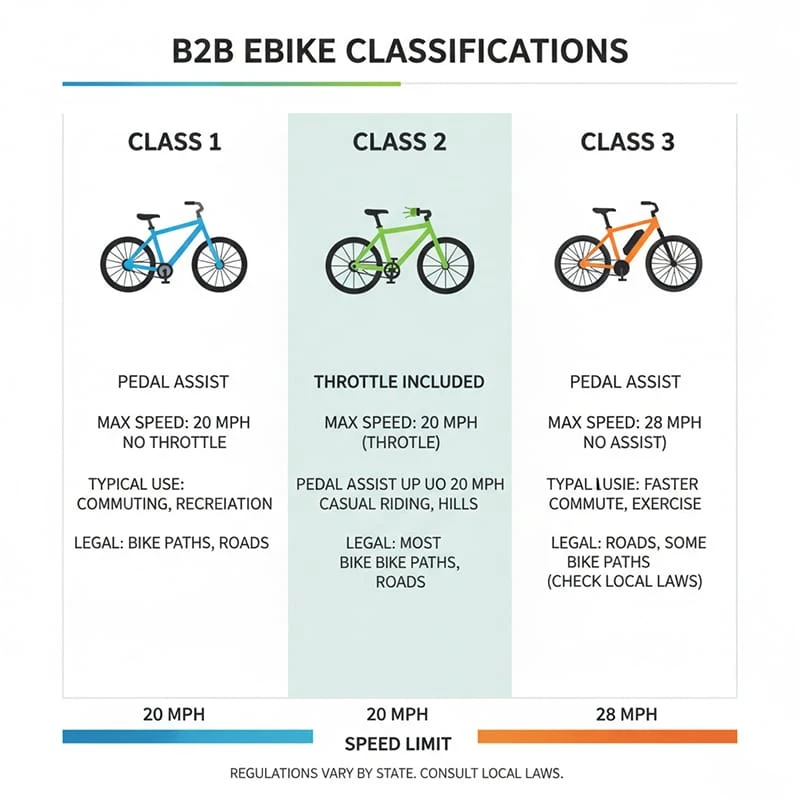
Class 1 Ebike
- Definition: An electric bike with a motor that provides assistance only when pedaling (pedal assist) and ceases at 20 mph.
- B2B Perspective: This is the "safe bet." It has the fewest restrictions globally. It is your inventory "safety net," especially in highly regulated urban markets.
Class 2 Ebike
- Definition: An electric bike with a motor that can propel the bike without pedaling (throttle) up to 20 mph.
- B2B Perspective: This is the US market's volume king. For most B2B inventories, Class 2 is a "must-stock" core due to overwhelming consumer preference for throttle-on-demand.
Class 3 Ebike
- Definition: A motor-assisted bike that requires pedaling and ceases at 28 mph.
- B2B Perspective: This is the high-performance, high-profit category. While these bikes command a premium, they carry higher regulatory burdens, often requiring speedometers and specific age/helmet laws.
B2B Inventory & Profit Strategy: Configuring Your Portfolio
A successful ebike business is about mastering the mix. Your configuration should be a deliberate strategy based on target market and business goals.
Class 1: Your "Go-Anywhere" Product
Class 1 models are the most universally accepted, making them the perfect entry point for new distributors.
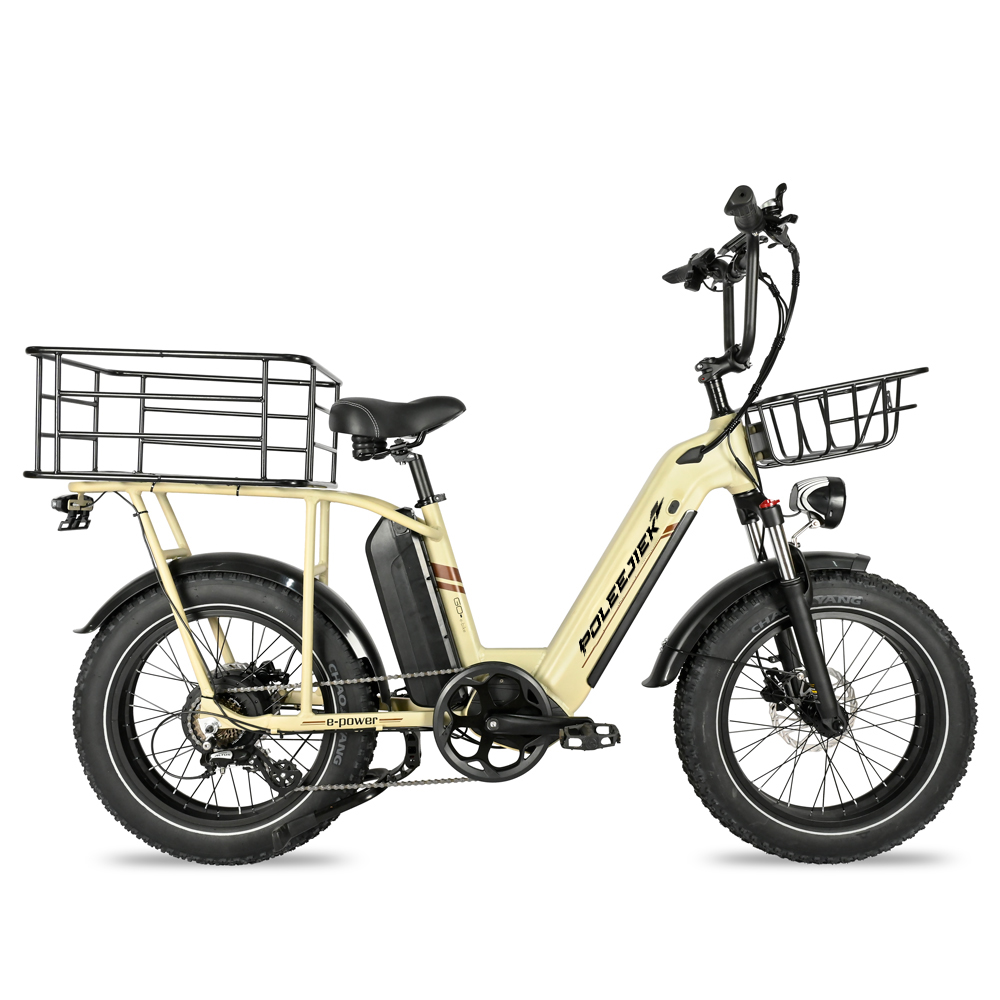
- Market Positioning: Ideal for electric cruiser bikes for park paths and entry-level commuter segments.
- B2B Advantage: Maximum compliance. These bikes are typically permitted wherever traditional bicycles are allowed, minimizing legal friction.
Class 2: Your "Profit Core" & US Mainstay
Class 2 drives ebike adoption in many segments. It's where the market's hottest trends live.
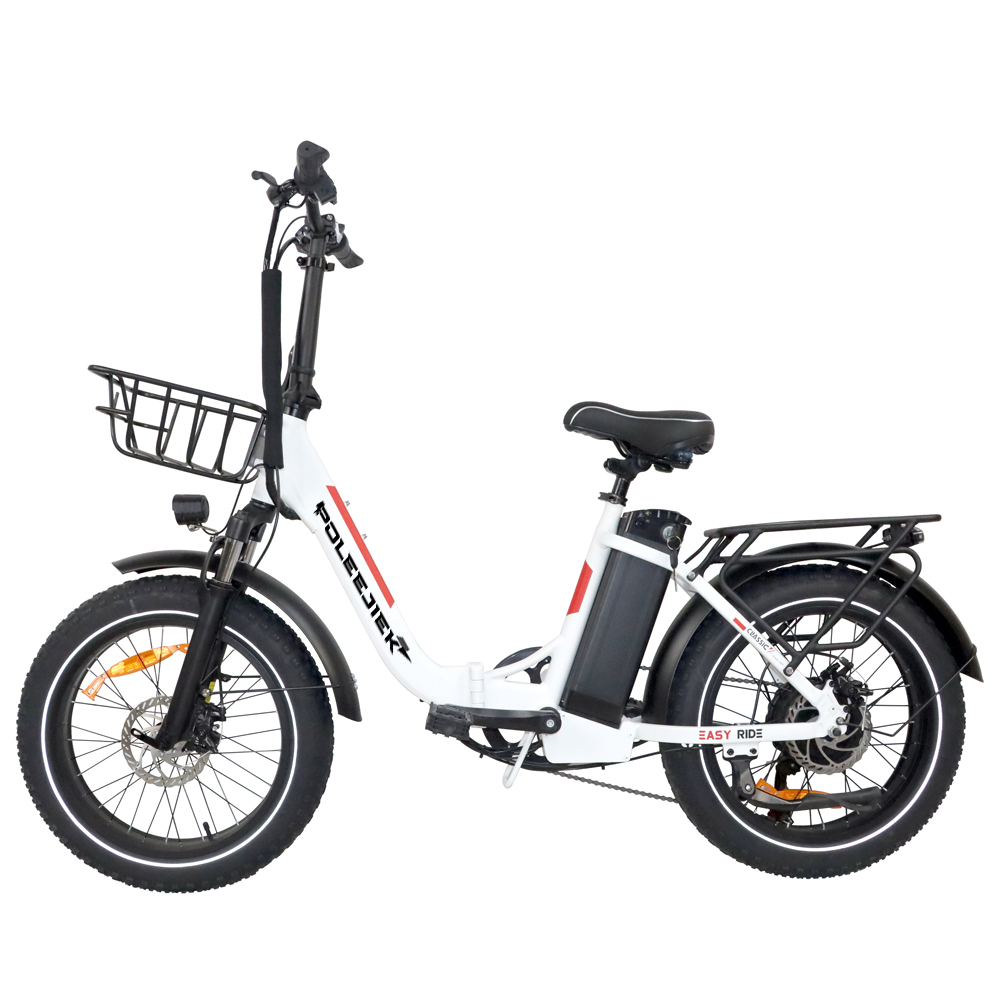
- Market Positioning: Think fat tire ebikes for all-terrain fun and folding models for urban commuters.
- B2B Advantage: High inventory velocity. Poleejiek’s market data shows that Class 2 models are the validated workhorses of a successful B2B portfolio.
Class 3: High-Margin Performance Flagships
Class 3 ebikes are faster and built with premium components, targeting affluent buyers who value speed.
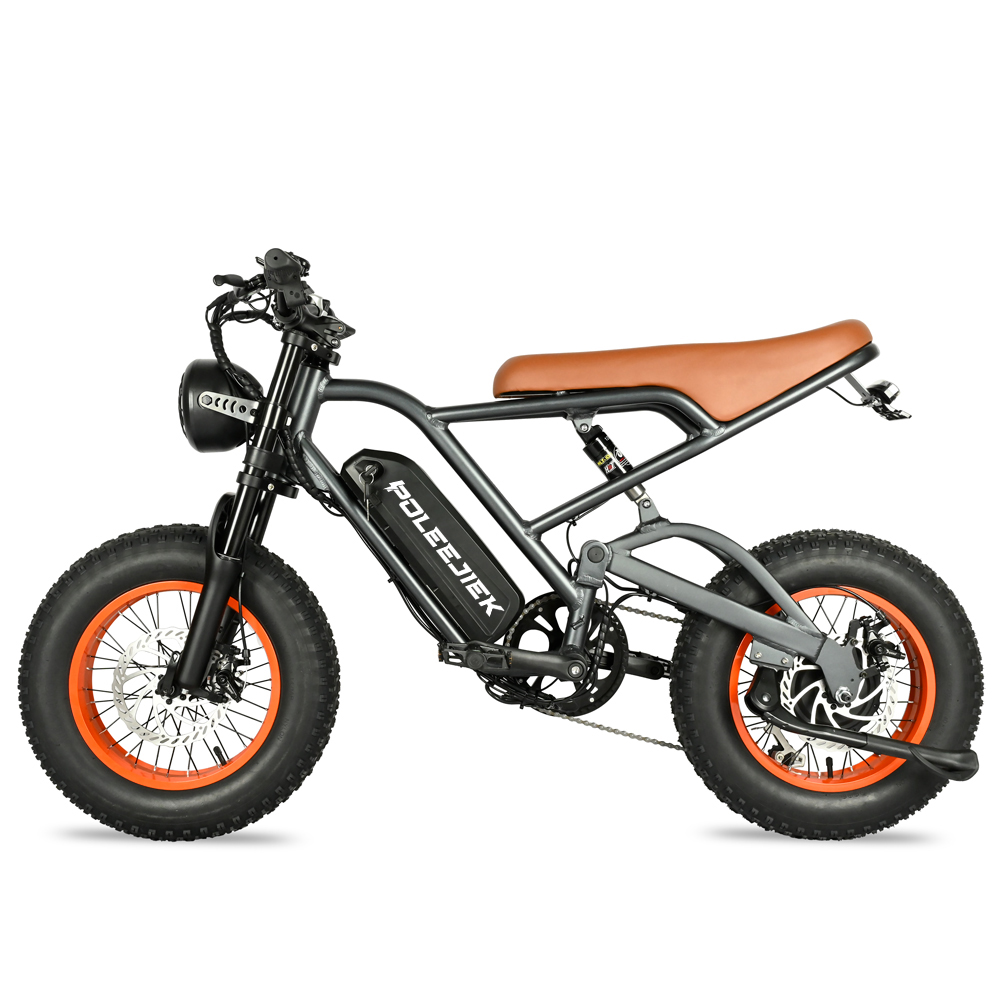
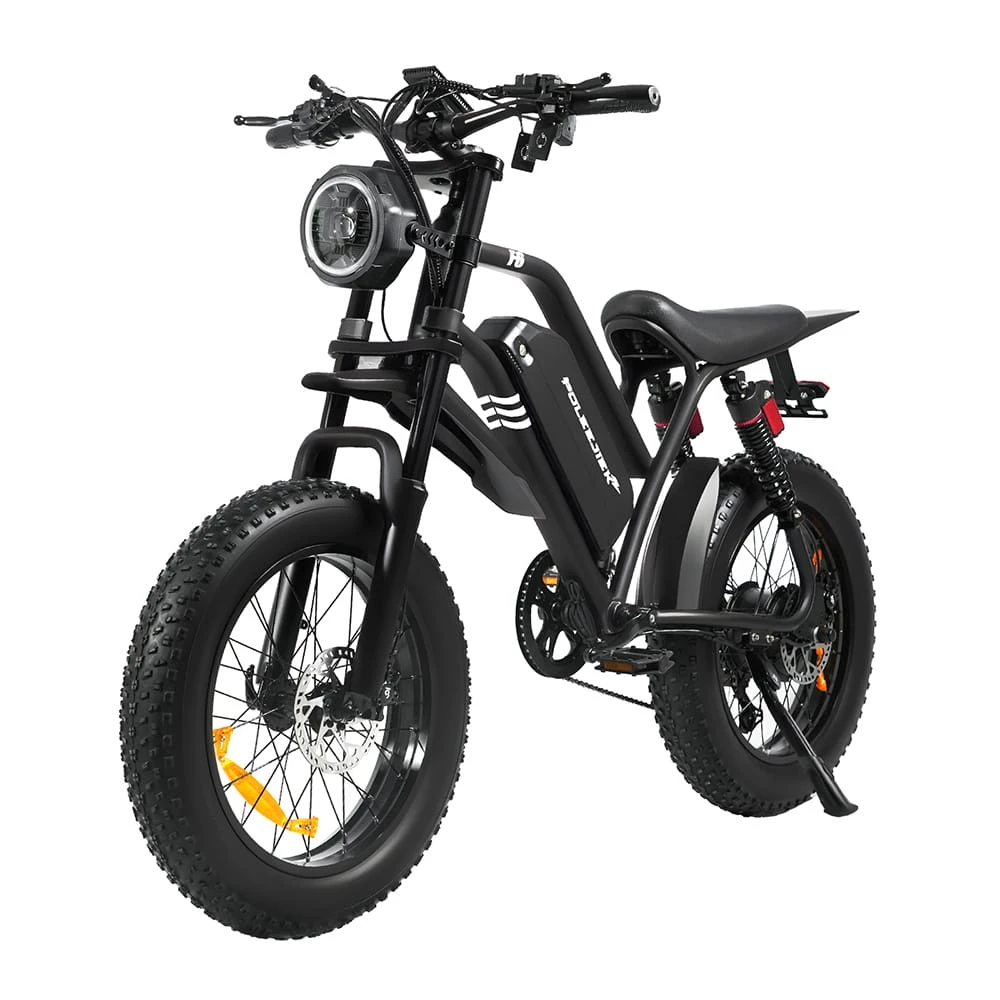
- Market Positioning: Positioned as fast electric bikes and long-distance commuters for car-replacement use.
- B2B Challenge: You must educate dealers on local laws. For instance, some states require registration or have age minimums for Class 3 riders.
The B2B Red Line: Avoiding the "Speed Trap"
Consumer keywords like "30 mph ebike" or "40 mph ebike" are legal landmines for B2B importers.
Why High-Speed E-Bikes are a Legal Nightmare
In the US, any two-wheeled vehicle over 28 mph or 750W is often reclassified as a Moped or Motorcycle. Importing a 1000w electric bike that isn't firmware-locked to legal limits can lead to:
- Customs Seizure: CBP and CPSC can seize non-compliant shipments at the port, leading to a 100% financial loss.
- Product Liability: Selling an "ebike" that is legally a "moped" voids your insurance, making your company personally liable for damages.
The Poleejiek Commitment: All our class 3 ebike models are strictly firmware-locked to legal speed limits, protecting your legal and financial safety.
Poleejiek: Your Strategic B2B Partner
Choosing a supplier means choosing a compliance partner. We provide the tools to mitigate the "Pain Points" that keep importers awake.
- Solution 1: Verifiable Firmware. We guarantee that every bike matches its CPSC-compliant label, verified and documented at the factory.
- Solution 2: Flexible MOQ. We allow B2B clients to mix Class 1, 2, and 3 models within a single container, maximizing cash flow and minimizing inventory risk.
Build Your 2025 Strategy Today.
Request Your Free B2B Market Analysis & Compliance Report